









Article
SFDR 2.0: ECON Position Sets Up a Fight Over Fossil Fuels in Transition Funds
Why product builders should care now
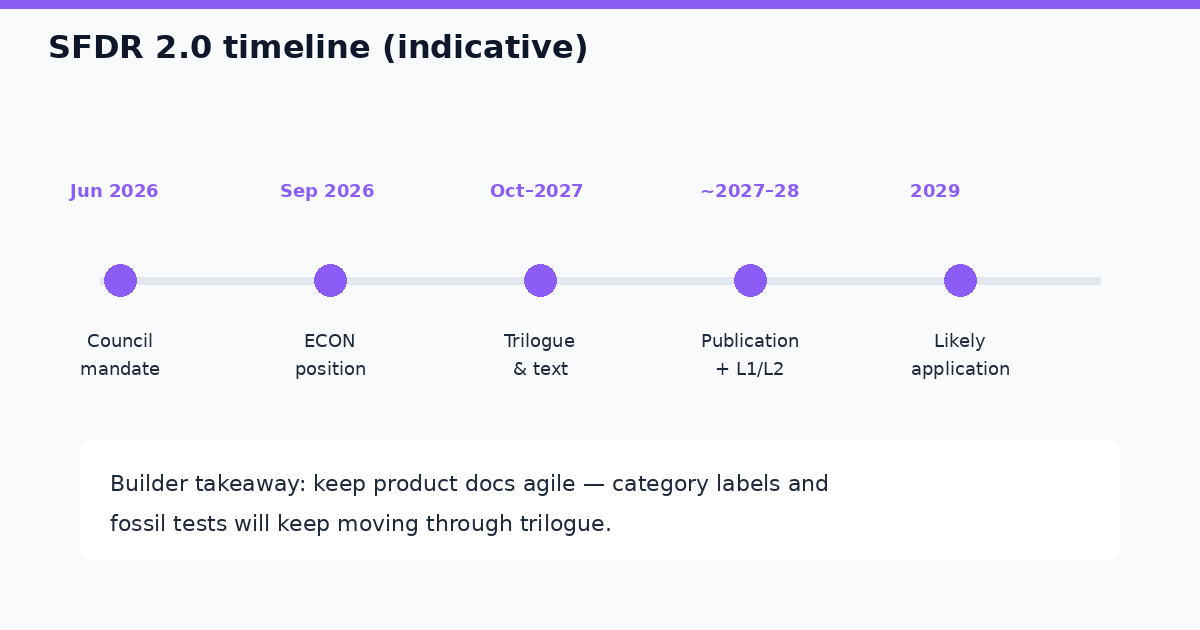
SFDR 2.0 will replace today’s Article 8/9 labelling fog with clearer product categories. Around 10 September 2026, the European Parliament’s ECON committee locked its negotiating position. That text now goes toward plenary endorsement and trilogue with the Council and Commission. For asset managers, fintech product owners and corporate IR teams pitching “transition” stories, the live question is simple: how much fossil-fuel exposure can sit inside a Transition product?
Application is still years away—most market briefings point to early to mid-2029 if a roughly 24-month implementation period follows a 2027 publication—but product architecture decisions made in 2026–27 will be expensive to unwind. Prospectuses, website copy and model portfolios all calcify faster than people admit.
The emerging three-category model
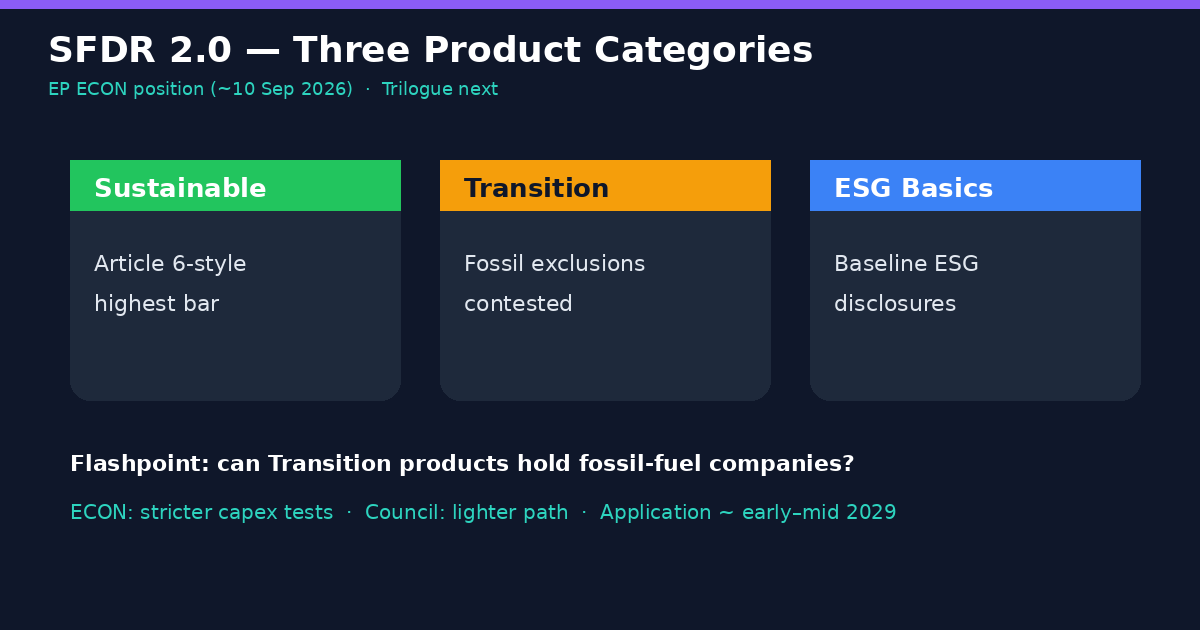
Commission, Council and Parliament broadly converge on three core buckets:
- Sustainable — highest environmental or social ambition, with the tightest exclusions.
- Transition — investments that are not yet sustainable but are meant to get there on a measurable path.
- ESG Basics — products that integrate ESG factors without claiming full sustainability credentials.
The political heat concentrates on Transition. The Commission originally pushed hard exclusions for fossil-fuel activities. The Council opened a path for fossil companies that meet a ~20% Taxonomy-aligned capex test plus time-bound Scope 1–2 reduction strategies. ECON kept a pathway but added sharper conditions—including that, over a rolling three-year period, Taxonomy-aligned capex must exceed capex on new fossil exploration/extraction projects, alongside coal phase-out expectations where relevant.
Trilogue will decide whether Transition remains a credible decarbonisation label or becomes a marketing umbrella. Product docs should stay modular until the final text lands.
 What remains contested heading into trilogue
- Fossil eligibility tests — absolute exclusions versus Taxonomy-capex gateways versus ECON’s “more green than new fossil” ratio.
- Hard coal and lignite carve-outs — Parliament retained tighter coal-related exclusions in places where Council was permissive.
- PAI and entity-level disclosures — how much principal adverse impact detail survives simplification rhetoric.
- Professional-investor opt-outs — whether wholesale channels get lighter regimes that retail cannot use.
- Implementation period — 18 versus 24 months after entry into force changes the late-2028 versus mid-2029 go-live math.
None of these points is cosmetic. Each changes which issuers can sit in flagship strategies and which marketing claims survive EmpCo-era scrutiny when consumer-facing channels describe “transition” credentials.
Builder checklist while trilogue runs
Separate marketing language from legal categories
Until Level 1 is final, avoid locking consumer-facing names that imply a finished EU category. Keep prospectus drafts with placeholders for exclusion screens. If sales teams need a story today, use plain-English portfolio construction language instead of borrowed regulatory labels.
Stress-test portfolios under both Council and ECON rules
Run holdings through the softer Council gateway and the stricter ECON ratio. If a flagship strategy only works under one scenario, escalate that risk to product governance now—not after distribution agreements are signed.
Upgrade issuer data asks
You will need Taxonomy-aligned capex, fossil expansion capex and credible transition plans—not just ESG scores. That data overlaps with ESRS climate transition-plan fields and corporate GHG inventories. Issuers that already publish Malaysia GHG or ISSB-style packs are easier counterparties; others will need structured questionnaires.
Watch green-claim enforcement in parallel
EmpCo restrictions on vague environmental claims (from late September 2026) already constrain how funds and corporates describe “green” or “transition” credentials in consumer channels. SFDR categories and EmpCo substantiation will reinforce each other. A Transition badge in 2029 will not rescue sloppy 2026 website copy.
Keep AI pricing and product ops flexible
If your platform prices sustainability-linked share classes or model portfolios automatically, do not hard-code today’s Article 8/9 logic into production. Build adapters so category tests can change without a full rewrite—the same modular habit that helps when ESG rating providers rotate under the new Ratings Regulation.
What “good” looks like for a Transition narrative today
Until trilogue ends, the safest Transition storytelling is operational, not label-based. Describe capital plans, abatement levers, Taxonomy-aligned capex already disclosed under CSRD/ESRS, and coal phase-out milestones with dates. Avoid implying that a portfolio already qualifies for a finished SFDR 2.0 category.
Corporate issuers pitching to European funds should expect sharper questions on fossil expansion capex versus green capex—the exact ratio ECON wants written into law. Prepare a one-page capital allocation bridge that finance and sustainability both sign. Funds that cannot obtain that bridge will either underweight you or park you outside Transition sleeves.
Fintech and wealth platforms should inventory every user-facing string that says “ESG,” “sustainable,” or “transition.” Map each string to a data field that can be swapped when Level 1 and Level 2 texts settle. That is cheaper than a 2029 emergency rebrand across apps, factsheets and model portfolios.
Sources
- Travers Smith — SFDR 2.0 European Parliament negotiating position
- Responsible Investor — What sticking points remain for SFDR 2.0 negotiations?
- ESG Today — Tougher fossil fuel rules for SFDR Transition category