









News
EU Data-Centre Sustainability Labels: A–G Ratings Arrive by 2027
Why this label matters for builders and buyers
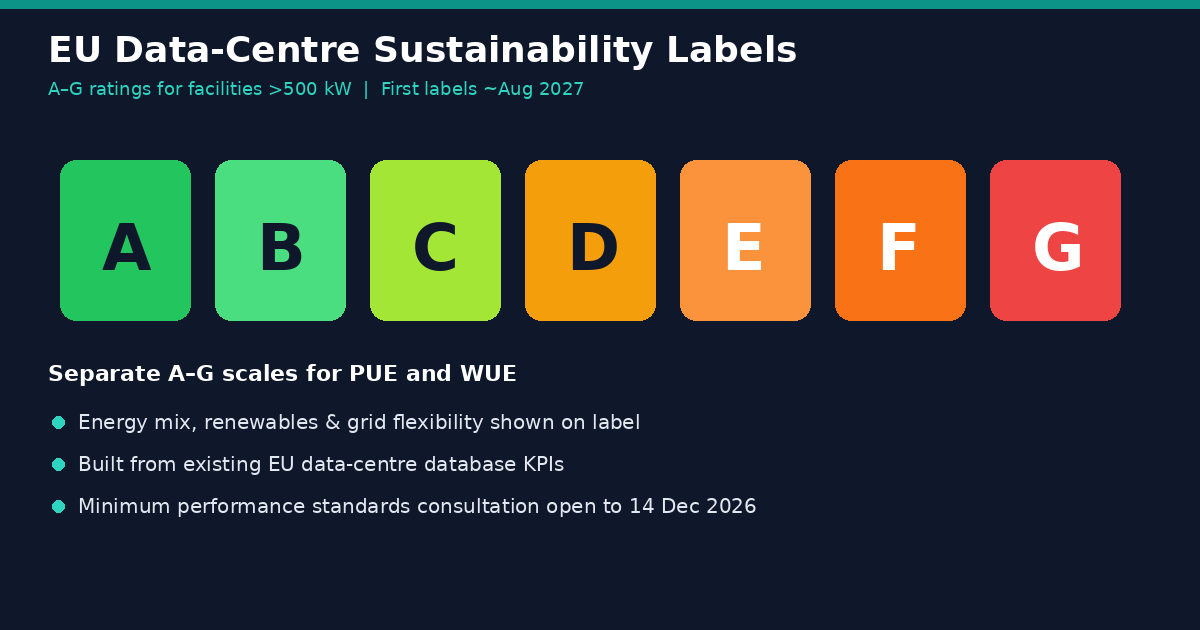
Europe wants to triple data-centre capacity over the next five to seven years while keeping grids, water systems and climate targets intact. In September 2026 the European Commission advanced a common Union rating scheme that turns existing KPI reporting into public, electronic sustainability labels for individual facilities above 500 kW of installed IT power demand. For founders placing AI workloads, colocation buyers negotiating SLAs, and operators planning capex, the label will soon sit beside price and latency as a decision factor.
This is not a sales pitch for any vendor. It is a practical briefing on what the scheme measures, when it bites, and how to prepare without ripping out working infrastructure. Treat it as another public-interest transparency tool in the same family as ESRS resource disclosures—useful even if you never sell “green cloud” as a product feature.
What the A–G label will show
Under the
proposed delegated regulation, the European database on data centres will generate an electronic label annually from information operators already report. Expect separate
A–G classes for Power Usage Effectiveness (PUE)
and
Water Usage Effectiveness (WUE)
, plus supporting fields that make the score usable in procurement:
Industry coverage of the draft thresholds highlights how steep the top bands are: an A-rated PUE around ≤1.15 and an A-rated WUE around ≤0.1, with G reserved for facilities above roughly 1.9 PUE or 1.0 WUE. Exact class boundaries belong in the legal annexes—treat press figures as directional and verify against the final delegated act before you
print them on a sales slide.
Because labels are generated from the existing reporting pipeline, the operational lesson is not “invent a new sustainability department.” It is “make the data you already send to the European database accurate, timely and defensibly metered.” Garbage in will become a public grade out.
Minimum standards are coming next
Transparency is step one. Alongside the label, the Commission opened a call for evidence and public consultation on minimum performance standards for data centres operating in Europe. That consultation runs through 14 December 2026, with a legislative proposal tentatively aimed at Q2 2027. Labels may soon be joined by binding floors—another reason to treat August 2027 as a planning milestone, not a distant PR date.
Operators in water-stressed regions should pay special attention to WUE context notes. A dry-climate facility and a Nordic free-cooling hall can look different on absolute water metrics even when both are well engineered. Buyers who understand that nuance will ask better questions; those who only chase a letter grade will mis-procure.
Founder playbook: useful work before the first label
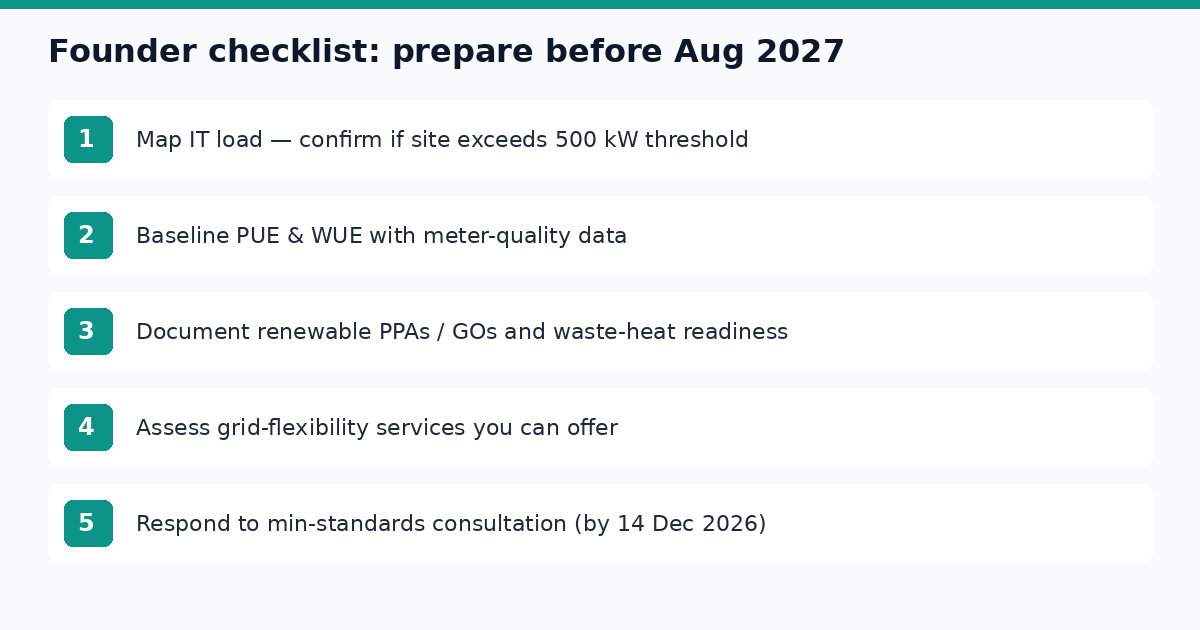
1. Confirm whether you are in scope
Map IT power demand per site. Anything above 500 kW that reports into the EU database is on the labelling path. Multi-hall campuses should document boundaries carefully so ratings attach to the right legal and operational entity. If you lease capacity, clarify whether the label will sit with the landlord operator or a separate reporting vehicle.
2. Fix measurement before you fix marketing
Buyers will compare labels. Weak metering produces noisy PUE/WUE and weakens trust. Prioritise sub-metering, water accounting and a change log that an auditor can follow. The same discipline supports related disclosures such as ESRS climate metrics and Malaysia GHG inventory work for regional groups.
3. Make renewables
and flexibility auditable
PPAs and guarantees of origin only help if they are attributable and documented. Grid-flexibility offers and waste-heat readiness should be engineering facts, not brochure lines—especially once EmpCo-style green-claim rules tighten vague environmental language on consumer and business marketing pages.
4. Respond to the consultation
If you operate or heavily procure EU capacity, submit evidence before 14 December 2026. Minimum standards will shape which cooling designs, density targets and heat-reuse investments remain economic through the decade.
5. Update procurement and pricing templates
Colocation and cloud RFPs should ask
for projected label class, WUE context, heat-reuse status and flexibility capability. Pair that with internal AI pricing models so sustainability is not an afterthought bolted onto unit economics. A cheaper rack that lands a G label may become a stranded conversation with enterprise buyers in 2028.
How this connects to the wider ESG stack
Data-centre labels sit beside CSRD/ESRS resource-use disclosures, TNFD nature dependencies for water-stressed sites, and buyer Scope 3 asks under ISSB-style regimes. Operators that already produce clean activity data will reuse it; those who treat each framework as a one-off PDF will burn cash.
The Commission proposal still faces a t
wo-month scrutiny period by Parliament and Council before entry into force. Watch for annex tweaks, but do not wait for perfect certainty to start metering and documentation work. The firms that look calm in August 2027 will be the ones that treated September 2026 as the start gun.
Sources