









News
California SB 253: CARB Moves Scope 1 & 2 Deadline to 10 Nov 2026
The short version for operators
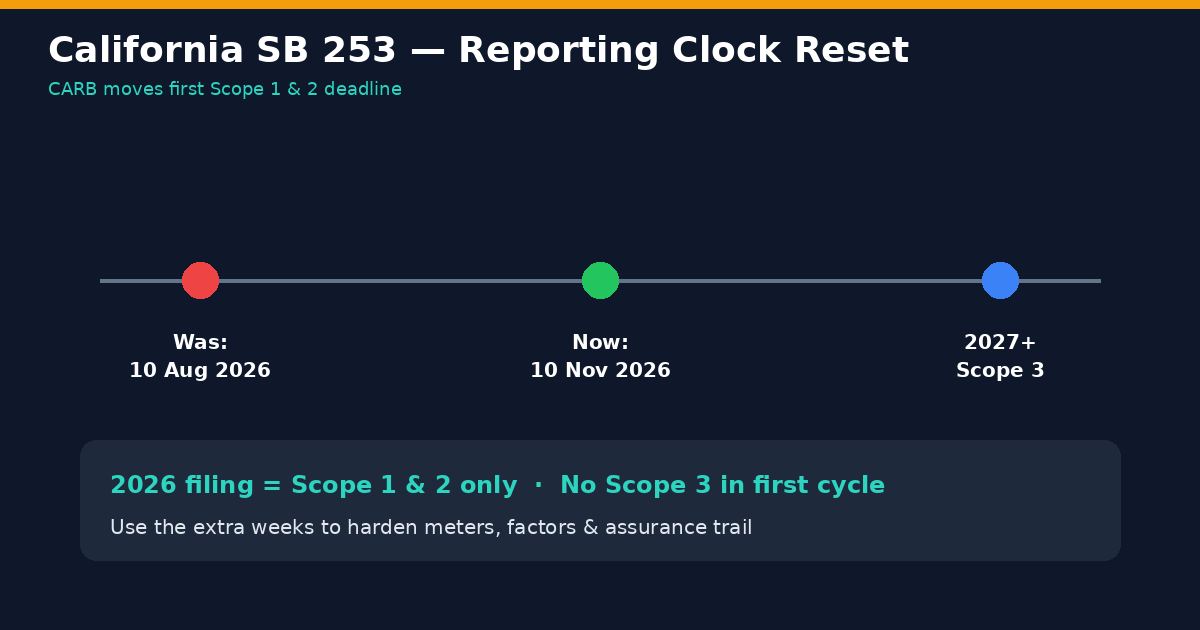
California’s Climate Corporate Data Accountability Act (SB 253) still requires large companies doing business in the state to disclose greenhouse gas emissions. What changed in 2026 is the calendar and the first-year scope. The California Air Resources Board (CARB) moved the initial Scope 1 and Scope 2 reporting deadline to 10 November 2026 (from an earlier August date) and confirmed that the 2026 cycle does not include Scope 3.
If you sell into California, run US subsidiaries, or sit in a global group whose California revenue crosses SB 253 thresholds, treat mid-November as a hard internal gate—not a soft “ESG nice-to-have.” The delay is real; the obligation is also real.
What CARB clarified for 2026
September 2026 guidance and an optional online intake platform spell out how first-year filings can work while longer-term rules finish their administrative path:
Practically, CARB is trying to get the first cohort through the door with usable numbers while the fuller regulatory machine catches up. That is a gift to operators who already measure; it is a trap for operators who interpret “flexibility” as “invent later.”
Practical workplan before 10 November 2026
Lock organisational boundaries
Decide equity-share versus operational-control approaches and stick to them. Inconsistent boundaries between California filings, CSRD/ESRS packs and voluntary GHG Protocol inventories create reconciliation debt that explodes when Scope 3 arrives. Write the boundary memo once; attach it to every future restatement.
Rebuild Scope 2 with dual reporting in mind
Location-based and market-based figures both matter to sophisticated buyers and lenders. Document contractual instruments (PPAs, RECs) with enough provenance that assurance providers can follow them later. If your market-based story depends on certificates, store serials and retirement evidence where finance—not a personal laptop—owns them.
Treat 2026 as the foundation year
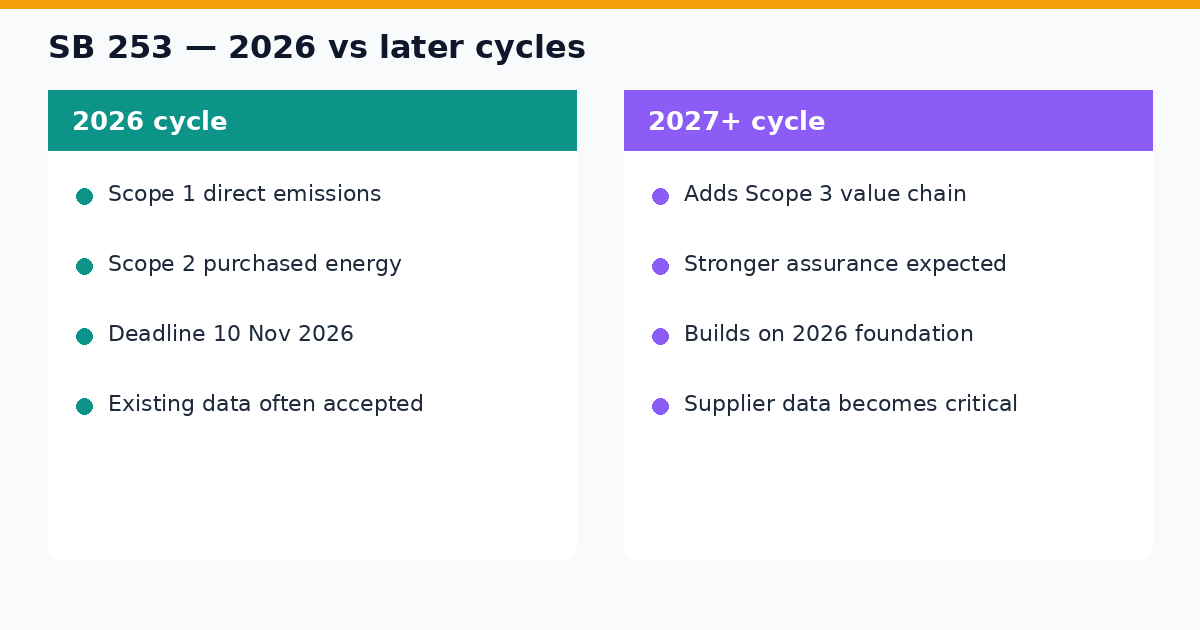
Even though Scope 3 is deferred, start supplier category mapping now. STI-listed partners in Singapore already face Scope 3 from FY2026; California filers will feel similar pressure in 2027. Activity data collected early is cheaper than emergency surveys, and it travels into TNFD-style nature screens when logistics or agriculture sit in your value chain.
Use the intake platform deliberately
Contact details and billing fields help CARB; emissions attachments may become public. Review what you upload. If you email instead, keep a dated evidence pack identical to what auditors will eventually want. Public numbers without a private workpaper trail are how restatement crises start.
Align legal and sustainability calendars
Litigation and rulemaking around SB 253 continue in the background. Operators should follow counsel on threshold questions, but should not pause data work waiting for every appeal to finish—the November date is the planning assumption CARB is using in its guidance materials.
How this fits a multi-regime stack
Teams that already maintain Malaysia GHG inventories, ESRS E1 climate tables, or ISSB-aligned packs can reuse emission-factor libraries and control matrices. The expensive path is building a California-only spreadsheet that cannot feed next year’s Scope 3 or EU filings.
Founders pricing carbon-aware products or AI workloads should also fold expected disclosure and assurance costs into unit economics—the same mindset covered in practical AI pricing discussions—so compliance does not surprise the P&L in 2027 when Scope 3 and tighter assurance land together.
If you only do one thing this month: nominate a single owner for the 10 November packet, freeze the factor library, and schedule a dry-run submission two weeks early.
Common first-cycle mistakes to avoid
Three failure patterns show up repeatedly in first-year climate filings. First, boundary drift: facilities open or close mid-year and nobody updates the inventory memorandum. Second, factor shopping: analysts quietly swap emission factors to hit an internal narrative without logging the change. Third, assurance amnesia: teams produce a pretty PDF with no workpapers, then scramble when limited assurance arrives in later cycles.
Build a mini control framework now: freeze the factor library with a change ticket, store meter extracts with timestamps, and run a peer review between sustainability and financial reporting before anything hits CARB. Those habits cost days in 2026 and save months in 2027 when Scope 3 multiplies the surface area.
Also brief commercial teams. Customers already ask for California climate status in RFPs. A clean 10 November filing is a sales asset; a late or non-reporting statement needs a rehearsed explanation that does not invent claims EmpCo-style consumer rules would also reject.
Sources